Mandarin duck
Aix galericulata
Mandarin duck

These ducks are mainly kept as ornamentals in Slovakia, as the males are very brightly colored, especially during the breeding season. In Malkia Park, you can spot this species with a careful eye on our lake, where these ducks are allowed to move more or less freely throughout the territory.
These animals cannot be adopted.
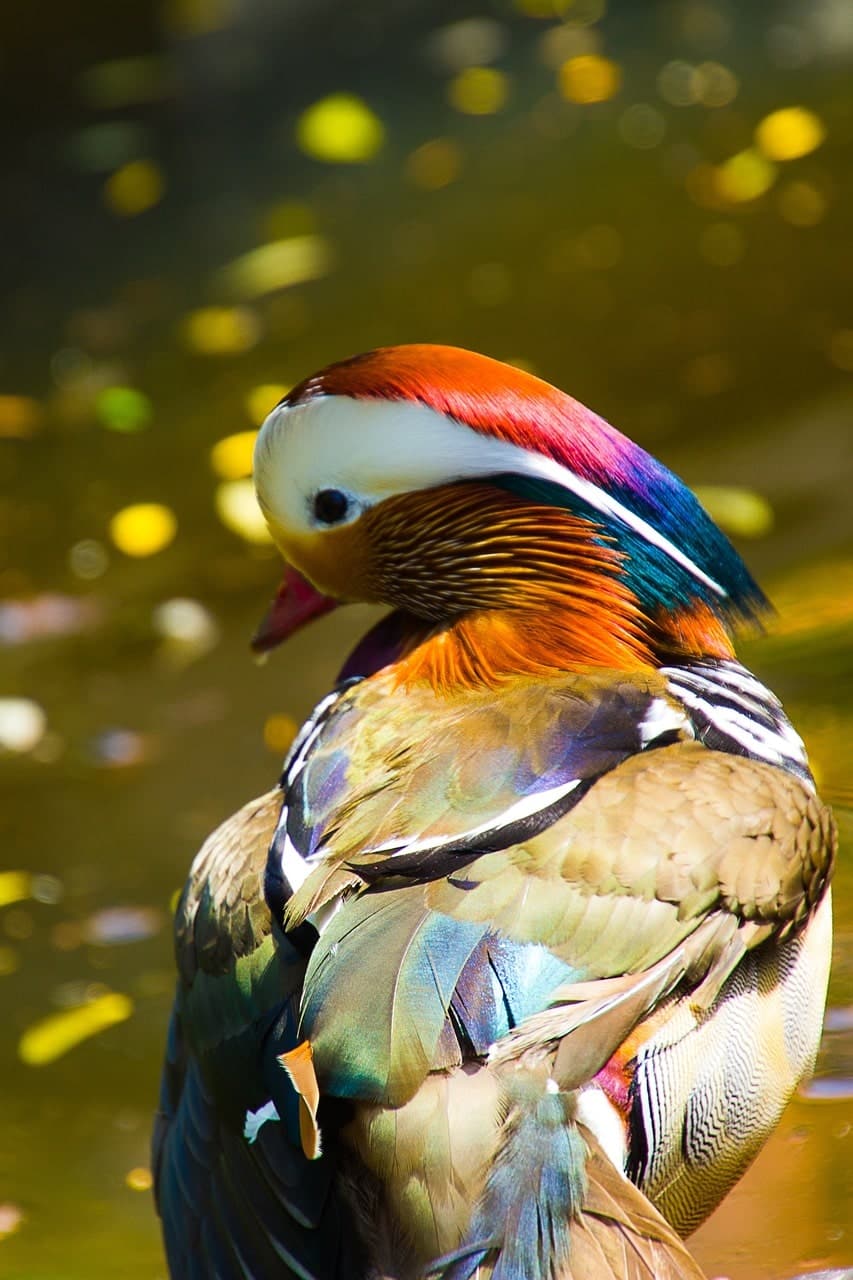
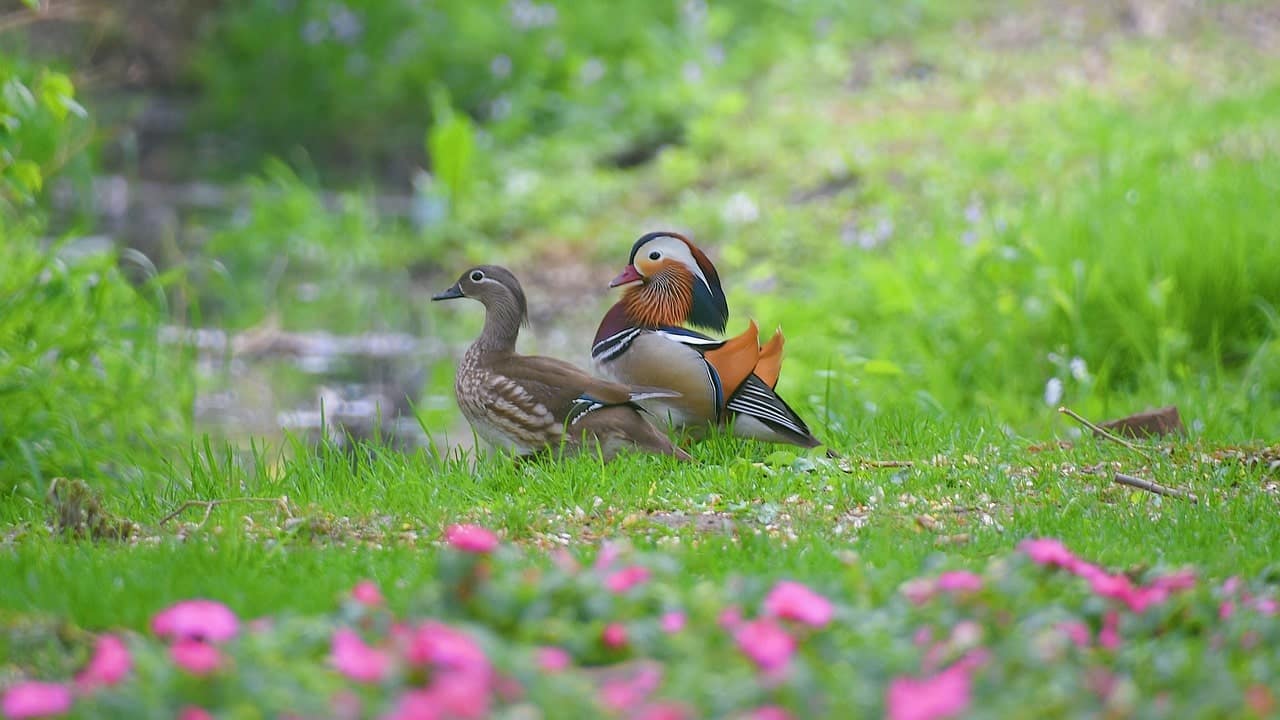
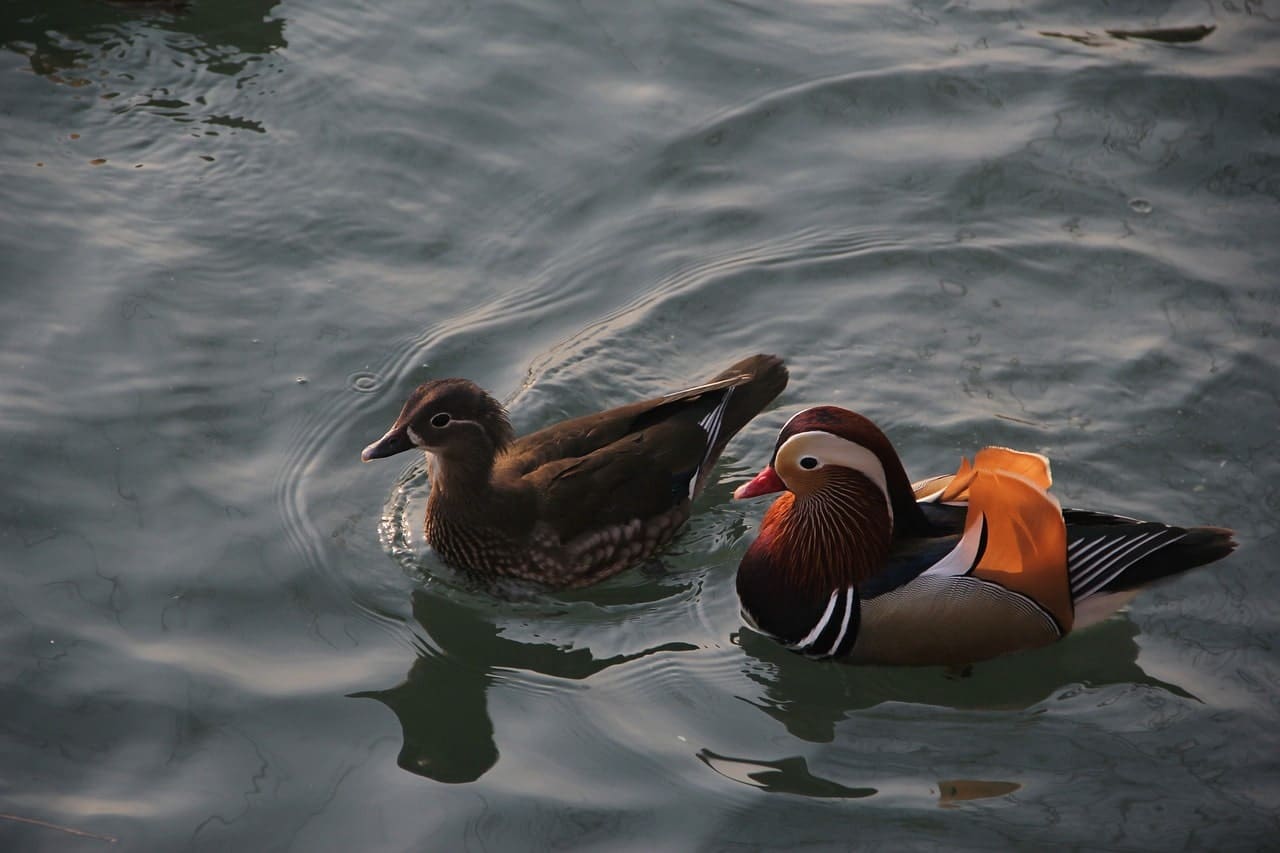
This species has a very pronounced sexual dimorphism. The male Mandarin duck has the most elaborate and ornate plumage with distinctive long orange feathers on the side of the face, orange “mirrors” on the back during breeding season, and light orange sides. The female is very dull in comparison. It has a grey head, a white stripe behind the eye, a brown back, and spotted sides. It looks quite similar to a female wood duck.
It lives in small flocks in forested areas, around rivers and lakes. It is a shy bird that escapes to the water surface when threatened. In its homeland, it migrates to rice fields and similar open, large wet areas in late summer. They are most active in the morning and evening when foraging for food.
The male’s beautiful colouring serves to attract a female with whom he might start a family in the spring. The male often performs interesting engagement dances. When the female chooses, she swims by her mate and drives the others away. The female sits alone on the eggs. A few days after hatching, the chicks must crawl out of the tree hollow to the ground, where the mother takes them to a pre-selected place with sufficient food sources.
In China, it was once customary to give newlyweds a pair of Mandarin ducks in a cage as a symbol of fidelity. This is strange, as this species does not form lifelong bonds, but each year, these ducks look for a different mate.
These ducks have been artificially introduced to various places in Europe. In England, for example, they have lived in wild since the 1930s. No coordinated introductions have yet taken place in our area, but we can see strays from private breeders, as this duck is very popular with breeders due to its bright colouring.
Outside the breeding season, the male bears a striking resemblance to the female.
The Mandarin duck cannot interbreed with other duck species as it has a different number of chromosomes in its cells.
Mandarin duck
Aix galericulata
Mandarin duck
Date of hatching
Unknown
Order
Family
BODY LENGTH
43-46 cm
Weight
630 g male
510 g female
LIFE EXPECTANCY
10-20 years
WINGSSPAN
70 cm
INCUBATION PERIOD
29-30 days
NUMBER OF EGGS
9-12 white eggs
CARE OF THE YOUNG
40-45 days
Occurrence
eastern Asia
Food
seeds, nuts, aquatic plants, occasionally molluscs
These ducks are mainly kept as ornamentals in Slovakia, as the males are very brightly colored, especially during the breeding season. In Malkia Park, you can spot this species with a careful eye on our lake, where these ducks are allowed to move more or less freely throughout the territory.
These animals cannot be adopted.
This species has a very pronounced sexual dimorphism. The male Mandarin duck has the most elaborate and ornate plumage with distinctive long orange feathers on the side of the face, orange “mirrors” on the back during breeding season, and light orange sides. The female is very dull in comparison. It has a grey head, a white stripe behind the eye, a brown back, and spotted sides. It looks quite similar to a female wood duck.
It lives in small flocks in forested areas, around rivers and lakes. It is a shy bird that escapes to the water surface when threatened. In its homeland, it migrates to rice fields and similar open, large wet areas in late summer. They are most active in the morning and evening when foraging for food.
The male’s beautiful colouring serves to attract a female with whom he might start a family in the spring. The male often performs interesting engagement dances. When the female chooses, she swims by her mate and drives the others away. The female sits alone on the eggs. A few days after hatching, the chicks must crawl out of the tree hollow to the ground, where the mother takes them to a pre-selected place with sufficient food sources.
In China, it was once customary to give newlyweds a pair of Mandarin ducks in a cage as a symbol of fidelity. This is strange, as this species does not form lifelong bonds, but each year, these ducks look for a different mate.
These ducks have been artificially introduced to various places in Europe. In England, for example, they have lived in wild since the 1930s. No coordinated introductions have yet taken place in our area, but we can see strays from private breeders, as this duck is very popular with breeders due to its bright colouring.
Outside the breeding season, the male bears a striking resemblance to the female.
The Mandarin duck cannot interbreed with other duck species as it has a different number of chromosomes in its cells.