Grivet
Chlorocebus aethiops
Judy, Anton, Jessy a Anna


The female kitten came to us from a private breeder.
Since primates cannot be alone, even in the wild they live in pairs or in groups, we are glad that he lives in his enclosure with a male from a foreign zoo. We gradually expanded the group by two more individuals of this species.
Not yet adopted
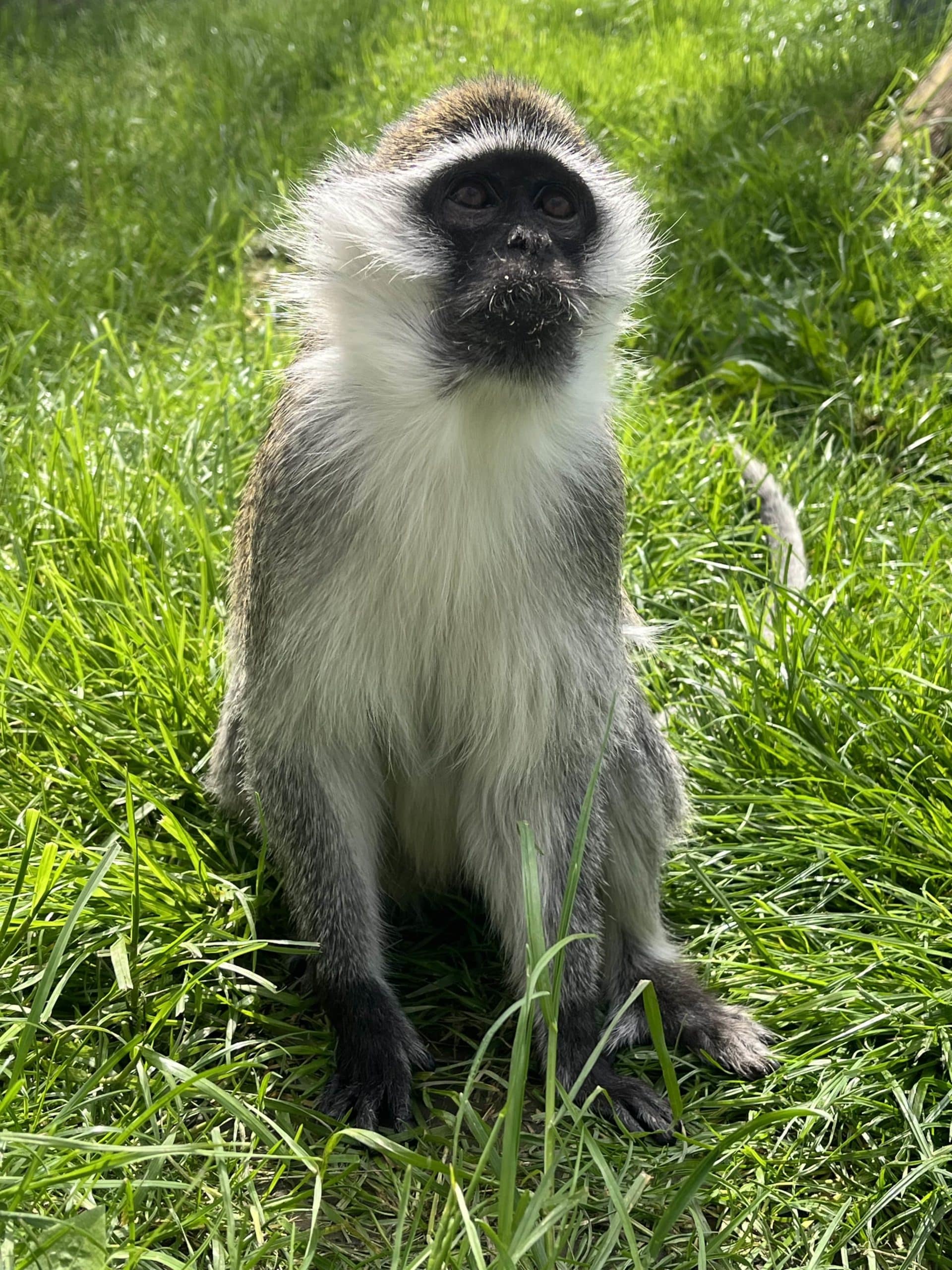
The grivet is also called the green grivet because of its golden-green coloured fur and pale coloured paws. It is also characterised by tufts of white hair on the sides of the face. The white edging of the black face extends along the neck and chest across the belly to the tail. A striking feature of the green grivet is its tail – it measures approximately 80 centimetres and is usually longer than the rest of the body.
Grivets live in larger troops (10-50 members), which mostly consist of a few females, their young, and a small number of males. A dominant male leads the troop, with changes in leadership occurring quite frequently.
Females mate with multiple males. Females help each other in caring for the young.
After birth, a grivet young can hold on to its mother not only with its arms and legs – but its tail is also adapted for holding. Gradually, however, this ability is lost.
Grivets are active in the morning and in the early evening.
During the day, they also descend to the ground in search of food. They sleep in the treetops.
Grivets spend much of the day playing, grooming, climbing trees, and pretended – playful competition. Games and coat grooming serve to strengthen social bonds.
A characteristic feature of this monkey is the various warning cries that signal members of the group that a particular enemy is approaching.
Grivet numbers are declining in the wild due to environmental degradation and illegal trapping of grivets for commercial purposes; grivets are also food for large snakes, leopards, Indigenous peoples, and baboons.
Monkeys contribute to the reproduction and spread of plants. They consume the fruit by not biting the seeds, which gradually pass through the entire digestive tract and are expelled with the droppings to places far away from the mother plant.
They have a wide variety of enemies. They serve as food for eagles, snakes, leopards, or other feline carnivores. Even baboons and crocodiles can catch them.
Grivet
Chlorocebus aethiops
Judy, Anton, Jessy a Anna
Date of birth
Judy: unknown
Anton: 21. 02. 2020
Jessy: 01. 06. 2014
Anna: 25. 02. 2019
Order
Family
BODY LENGTH
46-66 cm from head to root of the tail
Weight
2,5-7 kg
LIFE EXPECTANCY
10-13 years
LENGTH OF PREGNANCY
5-6 months
NUMBER OF YOUTHS
1
Occurrence
Sub-Saharan Africa, also introduced to Central America
Food
fruits, leaves, flowers, berries, grain, insects, baby birds
Judy, Anton, Jessy a Anna
The female kitten came to us from a private breeder.
Since primates cannot be alone, even in the wild they live in pairs or in groups, we are glad that he lives in his enclosure with a male from a foreign zoo. We gradually expanded the group by two more individuals of this species.
Not yet adopted
The grivet is also called the green grivet because of its golden-green coloured fur and pale coloured paws. It is also characterised by tufts of white hair on the sides of the face. The white edging of the black face extends along the neck and chest across the belly to the tail. A striking feature of the green grivet is its tail – it measures approximately 80 centimetres and is usually longer than the rest of the body.
Grivets live in larger troops (10-50 members), which mostly consist of a few females, their young, and a small number of males. A dominant male leads the troop, with changes in leadership occurring quite frequently.
Females mate with multiple males. Females help each other in caring for the young.
After birth, a grivet young can hold on to its mother not only with its arms and legs – but its tail is also adapted for holding. Gradually, however, this ability is lost.
Grivets are active in the morning and in the early evening.
During the day, they also descend to the ground in search of food. They sleep in the treetops.
Grivets spend much of the day playing, grooming, climbing trees, and pretended – playful competition. Games and coat grooming serve to strengthen social bonds.
A characteristic feature of this monkey is the various warning cries that signal members of the group that a particular enemy is approaching.
Grivet numbers are declining in the wild due to environmental degradation and illegal trapping of grivets for commercial purposes; grivets are also food for large snakes, leopards, Indigenous peoples, and baboons.
Monkeys contribute to the reproduction and spread of plants. They consume the fruit by not biting the seeds, which gradually pass through the entire digestive tract and are expelled with the droppings to places far away from the mother plant.
They have a wide variety of enemies. They serve as food for eagles, snakes, leopards, or other feline carnivores. Even baboons and crocodiles can catch them.