Leopard
Panthera pardus
Oscar


Some animals do not get to choose their home.
And some must fight for a second chance at life.
In Poland, the government confiscated several big cats that had been kept for many years by a private individual in inappropriate and cruel conditions, along with more than 80 other animals. For many of them, this meant a life without space, without stimulation, without safety… a life without dignity.
Polish zoological gardens, together with the Polish government, then tried to place the big cats in various zoos. However, the reality is far more complicated than it may seem.
Big cats cannot simply be added to existing animals — this would lead to serious, often even fatal, conflicts. Zoos would have to divide their enclosures and reduce the space for animals already living there, or build entirely new enclosures, which is extremely demanding in terms of time, finances, and space.
And that was when a request reached us as well.
To Malkia Park.
As we were still building new enclosures at the time, we were able to open our doors to those who needed it most. That is how Oscar the leopard came to us, together with the tigers Kenzo, Chance, and Diesel.
Oscar is in our care as part of a deposit — safe and protected, in a place where his story did not end, but began anew.
Today, we strive to provide them with the best and most dignified living conditions possible — with enough space, professional care, and enrichment that helps them rediscover their natural behaviour.
But every such story comes at a cost.
By adopting an animal, you become part of its second chance.
You help us provide food, veterinary care, enrichment, and a dignified life to those who could not fight for it on their own.
Oscar has a new home.
Perhaps now, he is only missing you.

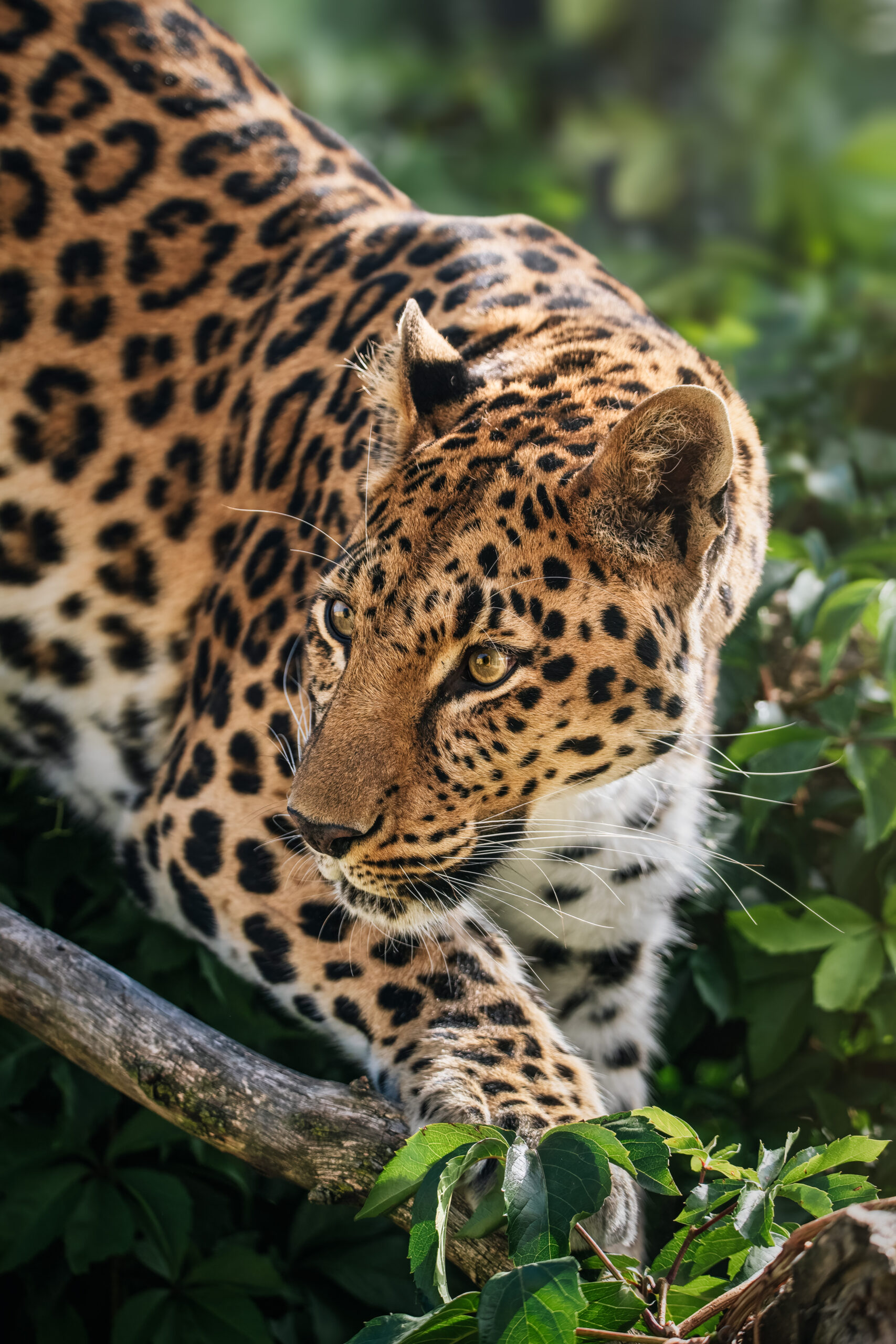
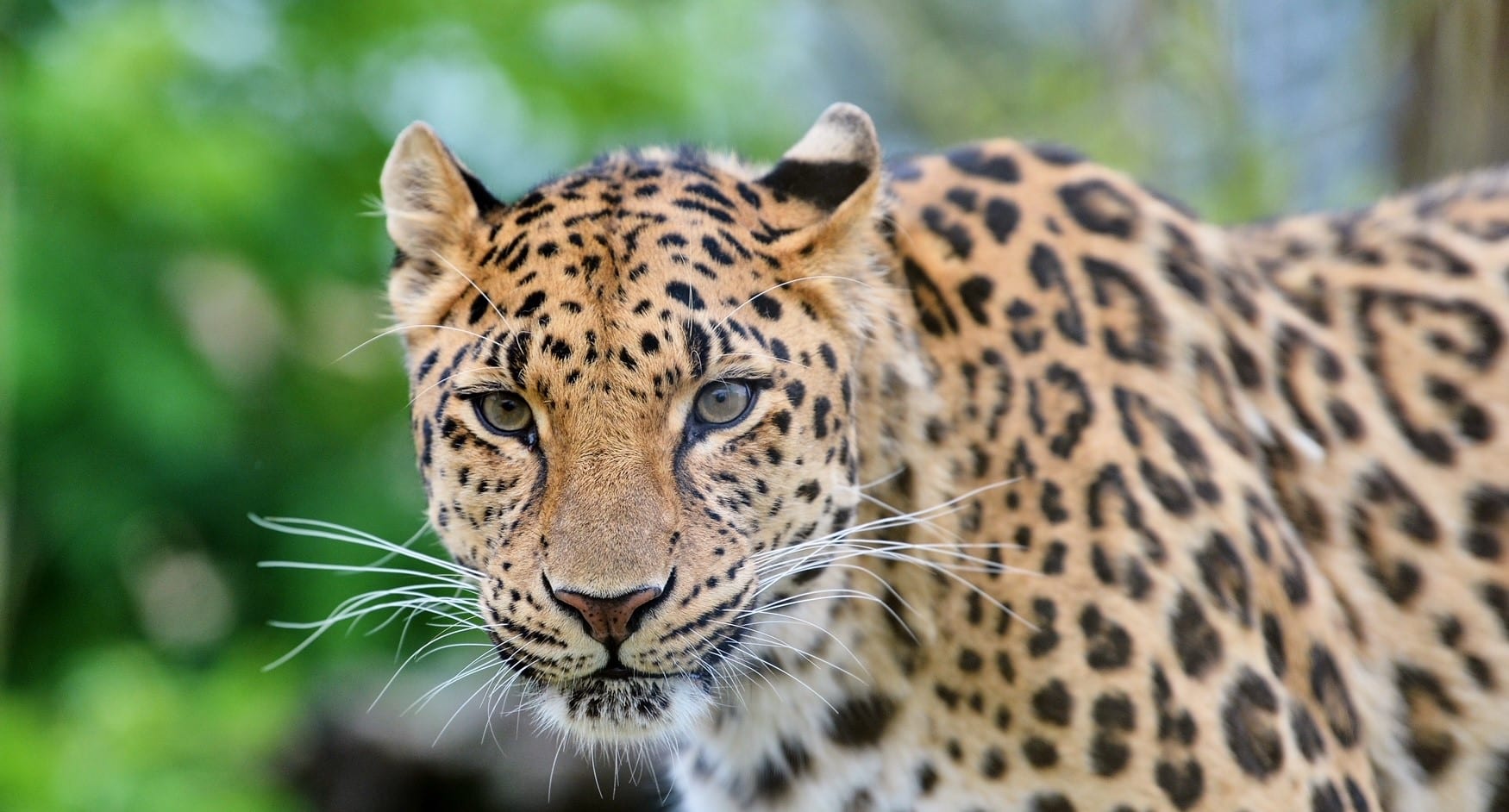
The basic colour of its coat ranges from pale brown to black. The contrasting colouring and pattern of its fur allows the leopard to camouflage itself perfectly. It is almost invisible in the environment it inhabits.
Melanism occurs in the leopard. As a result of the genetic mutation, the skin and coat contain a lot of dark pigment-melanin. In deserts, leopards are creamy yellow, in grassy areas dark yellow. Melanistic – black – leopards are found mainly in moist dense forests. The black colouring does not bother it at all. With its excellent eyesight and hearing, the leopard with its extremely long touch-sensitive whiskers is perfectly equipped for night hunting.
It climbs well, has very strong scapular and foreleg muscles.
Solitary, territorial hunter. The male leopard meets the female only during the breeding season. After a relatively short gestation period of about three months, the female takes care of the young on her own. The young are born deaf, blind, and weighing only about 500 g. The eyes open at nine days, when the spots start to become visible. Until then, the young appear to be unicolour. The female and her young often change hiding places to avoid falling prey to lions, hyenas, or male leopards. Mostly two young survive, staying with their mother for two years while the mother teaches them hunting tactics.
When catching the prey, it climbs with it into the treetops (sometimes up to 6 meters high) so that other beasts (hyenas and jackals) would not steal it and eats it in peace. In nature, it performs a sanitary function – it hunts only sick, old, injured individuals, and young.
Leopard drinks as much as possible every day, but can go almost a month without water.
Leopards have an excellent sense of direction. The group, captured near Nairobi and relocated to Tsavo National Park, 320 km away, returned after a few weeks.
The so-called “black panthers” were once considered a separate species or subspecies. It is now clear that this is just a melanistic form of the leopard or jaguar. Even on a black substrate, the typical spots are clearly visible at a certain angle of light. A female can have both black and classically coloured young in her litter.
A leopard has twice better the hearing and six times better the vision of a human in the dark.
Leopard
Panthera pardus
Oscar
Date of birth
Unknown
Order
Family
BODY LENGTH
100-130 cm
HEIGHT
50-60 cm at shoulder
Weight
65-80 kg
LIFE EXPECTANCY
12 years in the wild, up to 20 years in captivity
LENGTH OF PREGNANCY
90-112 days
NUMBER OF YOUTHS
2-6
Occurrence
much of Africa and southern Asia
Food
large and small mammals and birds
Oscar
Some animals do not get to choose their home.
And some must fight for a second chance at life.
In Poland, the government confiscated several big cats that had been kept for many years by a private individual in inappropriate and cruel conditions, along with more than 80 other animals. For many of them, this meant a life without space, without stimulation, without safety… a life without dignity.
Polish zoological gardens, together with the Polish government, then tried to place the big cats in various zoos. However, the reality is far more complicated than it may seem.
Big cats cannot simply be added to existing animals — this would lead to serious, often even fatal, conflicts. Zoos would have to divide their enclosures and reduce the space for animals already living there, or build entirely new enclosures, which is extremely demanding in terms of time, finances, and space.
And that was when a request reached us as well.
To Malkia Park.
As we were still building new enclosures at the time, we were able to open our doors to those who needed it most. That is how Oscar the leopard came to us, together with the tigers Kenzo, Chance, and Diesel.
Oscar is in our care as part of a deposit — safe and protected, in a place where his story did not end, but began anew.
Today, we strive to provide them with the best and most dignified living conditions possible — with enough space, professional care, and enrichment that helps them rediscover their natural behaviour.
But every such story comes at a cost.
You help us provide food, veterinary care, enrichment, and a dignified life to those who could not fight for it on their own.
Oscar has a new home.
Perhaps now, he is only missing you.
The basic colour of its coat ranges from pale brown to black. The contrasting colouring and pattern of its fur allows the leopard to camouflage itself perfectly. It is almost invisible in the environment it inhabits.
Melanism occurs in the leopard. As a result of the genetic mutation, the skin and coat contain a lot of dark pigment-melanin. In deserts, leopards are creamy yellow, in grassy areas dark yellow. Melanistic – black – leopards are found mainly in moist dense forests. The black colouring does not bother it at all. With its excellent eyesight and hearing, the leopard with its extremely long touch-sensitive whiskers is perfectly equipped for night hunting.
It climbs well, has very strong scapular and foreleg muscles.
Solitary, territorial hunter. The male leopard meets the female only during the breeding season. After a relatively short gestation period of about three months, the female takes care of the young on her own. The young are born deaf, blind, and weighing only about 500 g. The eyes open at nine days, when the spots start to become visible. Until then, the young appear to be unicolour. The female and her young often change hiding places to avoid falling prey to lions, hyenas, or male leopards. Mostly two young survive, staying with their mother for two years while the mother teaches them hunting tactics.
When catching the prey, it climbs with it into the treetops (sometimes up to 6 meters high) so that other beasts (hyenas and jackals) would not steal it and eats it in peace. In nature, it performs a sanitary function – it hunts only sick, old, injured individuals, and young.
Leopard drinks as much as possible every day, but can go almost a month without water.
Leopards have an excellent sense of direction. The group, captured near Nairobi and relocated to Tsavo National Park, 320 km away, returned after a few weeks.
The so-called “black panthers” were once considered a separate species or subspecies. It is now clear that this is just a melanistic form of the leopard or jaguar. Even on a black substrate, the typical spots are clearly visible at a certain angle of light. A female can have both black and classically coloured young in her litter.
A leopard has twice better the hearing and six times better the vision of a human in the dark.